Three reasons why your business needs a blog
Key summary (TL:DR)
Your audience consists of customers and prospects who have questions that you can answer. Therefore, creating a connection is key.
Be relevant, be relatable: be yourself.
To blog is to own digital real estate: a space your business controls where you can share your expertise, ideas, and unique POV.
A well-oiled distribution strategy can help your blog content reach more of the people your business wants to connect with.
Just like a storefront, a company’s blog is a microcosm of its knowledge, authenticity, and passion. But knowing how to express your hard-won expertise through writing is a delicate art. It requires a clear understanding of your clientele and knowledge of search engine optimization (SEO) best practices. Full of tricks and tips, this article will clearly demonstrate why it’s essential to stay active on your blog in 2026.
#1 - An opportunity to show your audience that you get them
Picture this: it’s Friday night, and you’ve spent the entire week perfecting what you believe is the perfect blog post for your website. You got right to the point and described your services with pretty, persuasive language and just the right dose of non-cheesy salesmanship.
You post it without thinking twice, close your laptop, and move forward to another task on your to-do list. Congratulations, but you just committed several blog faux pas, including building the core of your blog post using the voice of a copywriter rather than a content writer.
But don’t panic; you can fix this.
First, you need to take a step back and understand the differences between content writing vs. copywriting, as they aren’t the same. A blog post is content writing, which is writing that is meant to first and foremost educate and inform.
Although both copy and content serve to create connection and resonance with your audience, the way you go about achieving said resonance isn’t the same.
Put yourself in your customers’ or prospects’ shoes. What do they care about? Why do they come to you? Your goal is to identify their problems and challenges by sharing knowledge that is relevant to them—not to sell or persuade them on why you’re the best. To do so, draw inspiration from their most frequently asked questions and explore various ways to address them.
Ultimately, blogging is about providing useful information about your customers’ most pressing questions, which tend to be linked to their problems and challenges. In so doing, you’ve just created an opportunity to position yourself as an expert (which we’ll elaborate more on below in point #3).
“A blog post’s primary goal is to educate and inform.”
Creating connection with an authentic voice
While embarking on the process, it’s important to return to a fundamental principle: that one of the main goals of a writer, regardless of the medium, is authenticity. The more comfortable you’ll be in your narrative voice, the more relatable you’ll become.
And saying something relatable matters.
Writing in an authentic voice can help you stand out and attract the right clientele for your business. In a world filled with unrememberable content generated by artificial intelligence, it’s never been more important to be human, to be real, to be yourself.
Don’t take yourself too seriously.
If your brand voice and industry permit it, sprinkling your writing with touches of humour and irony can help reinforce your position as an expert—one so confident in their expertise that they can bring a sense of lightness to a subject they’ve mastered perfectly.
Pro tip: If in need of inspiration, make a list of all the questions or common issues your customers have and turn each one into an effective blog post.
# 2 - The gift that keeps on giving
To blog is to own digital real estate: its value can be maximized and grow over time with the right amount of management. Your blog space has to be seen as a catalyst that provokes the transformation of attention into action. Essentially, of readers into customers.
But to increase the impact of your voice, you have to let it echo across social media channels–think IG, FB, LinkedIn, etc. The good news? A single blog article is a multifaceted source of content that, when promoted on your socials, helps drive traffic back to your website.
“Your blog space has to be seen as a catalyst that provokes the transformation of attention into action.”
Dissemination is key
A well-oiled distribution strategy is important for building your audience and attracting your ICP or “Ideal Customer Profile”.
Imagine placing a magnifying glass over your article—each section can be turned into a post you can share and reshare throughout the year on Instagram, LinkedIn, Substack, Facebook, or wherever else your brand lives. Don’t worry—your audience won’t notice that what they are reading is from the same source, as you played it smart by creating a post per section of your article.
One blog, a dozen possibilities – isn’t it great?
Indeed, but remember… posting is just half of the work.
After sharing the main takeaways of their blog article on social media, a great blog writer takes the time to answer their comments while commenting on others' posts, sending new connection requests. The simple act of interacting with the platforms is rewarded. This engagement shows the platform-specific algorithm that you are not a passive user but a dynamic contributor to their community.
Micro content
Micro content is a smaller piece of content created from a larger piece of content. It means using the versatile nature of a post to extract a short, useful excerpt from it that tackles one specific idea, tip, question, quote, or takeaway from the article.
Here are some concrete examples of the different forms of micro content you can create from different parts of the same blog post.
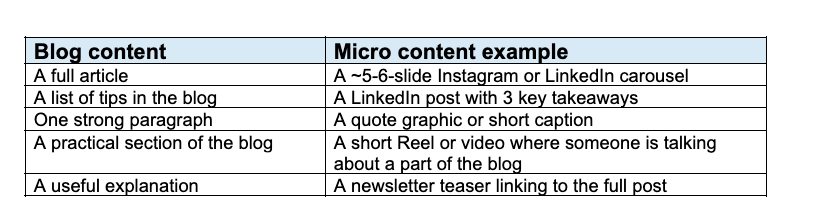
The goal? Hook the audience with a condensed version or one portion of your blog that makes readers eager to discover more. This can naturally direct them to the version that explores the subtleties, nuances, and different perspectives on the same topic.
#3 - Flex your experience and deep knowledge
A blog gives you room to demonstrate what you know, how you know it, and what you have learned through your hard-won professional experience. This can help your readers understand the depth behind your business and unique offering, rather than simply taking your claims at face value.
One useful lens for evaluating blog content is Google’s E-E-A-T framework. “E-E-A-T” stands for Experience, Expertise, Authoritativeness, and Trustworthiness. While E-E-A-T isn’t a ranking formula, it can help you think more critically about the quality, credibility, and usefulness of what you set out to write and publish.
In practice, that may mean:
Drawing on first-hand knowledge, observations, or examples where relevant (Experience)
Explaining the subject with accuracy, depth, and a clear understanding of the field (Expertise)
Supporting your ideas with credible sources and showing why your perspective is worth paying attention to (Authoritativeness)
Being transparent, reliable, and careful not to make claims that you cannot support (Trustworthiness)
In other words, strong blog writing often strikes a balance between offering advice as a friend would and bringing a professional, informed perspective to the conversation.
What’s more, with so much generic and AI-generated content circulating online, there appears to be a growing premium on real human expertise. And this seems to be supported by various content marketing experts.
On May 20th, we attended Search Engine Journal’s webinar, “The New Rules of Search: Key AEO & Content Marketing Trends for 2026,” featuring panellists Shannon Vize and Patrick Reinhart from Conductor. One of the main takeaways pertains to the renewed emphasis on promoting your unique take and expertise, including conducting proprietary research. The idea here is that speaking from the perspective of one’s deep expertise can encourage LLMs to reference you as an authoritative source. In particular, the panellists cited proprietary research as “the highest-value citation driver”.
Pro tip → You can assess the usefulness and reliability of your content yourself using Google tools, such as Google Search Central, which guides you through a series of questions to help you determine whether your content is “people-first” or focused on search engine performance.
The good news: Keyword research isn’t dead
With the rise of LLMs and AI search, there’s been a lot of chatter about how Search Engine Optimization (SEO) keyword research has been rendered obsolete. We see it differently. Understanding what your audience searches for—and the language they use to describe their needs—can still provide a valuable foundation for content planning.
As the data-driven SEO consultant Andy Chadwick highlighted in his article “Why Keyword Research Isn’t Dead”, SEO keywords were and still are important. Rigorous background research of the words, short phrases, and topics related to your brand or business is important since it can help inform your choice of blog topics.
Your goal is to ensure that when your client searches for something relevant to your area of expertise, your website appears among the top search results—primarily through the effective use of keywords and semantically related terms.
According to HubSpot, the perfect combination would be to choose keywords with a high search volume and achievable difficulty, while keeping them inspiring and relatable for your content. High “KD” or keyword difficulty typically signals high competition, which means that it could potentially be more challenging to rank for.
Who should write my blog posts?
Whether you're short on inspiration or time, or simply need to prioritize, Simile Agency offers a range of writing services that let you stay up to date while knowing your blog is in good hands.
From polishing your blog posts, SEO strategy and content roadmap, to monthly blog content, we offer blog packages tailored to suit your needs and budget.
No more ideas left on the drawing board—your voice deserves to be heard. Ultimately, you are the source and expert, and we are the facilitators.
Want to solidify your market position? Hiring talented wordsmiths who can convey trust and an authoritative voice is a wise first step.
Get in touch today: info@simileagency.com